(China (Mainland))



Product Summary
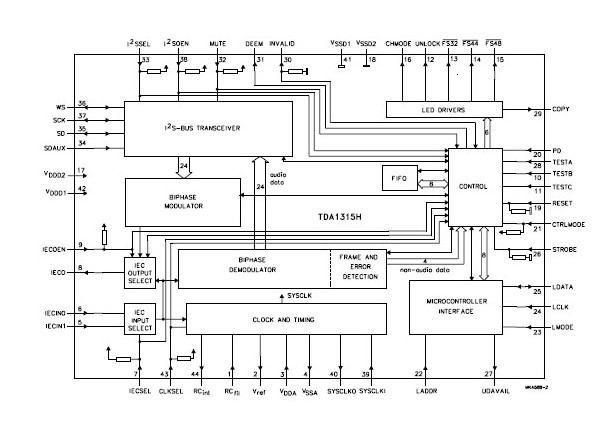
The Digital Audio Input/Output circuit (DAIO) of the TDA1315H/N2 is a complete transceiver for biphase-mark encoded digital audio signals that conform to the SPDIF and “IEC 958” interface standards (consumer mode), made in the full CMOS-process C200. In the receive mode, the TDA1315H/N2 adjusts automatically to one of the three standardized sample frequencies (32, 44.1 or 48 kHz), decodes the input signal and separates audio and control data. A clock signal of either 256 or 384 times the sample frequency is generated to serve as a master clock signal in digital audio systems. In the transmit mode, the TDA1315H/N2 multiplexes the audio control and user data and encodes it for subsequent transmission via a cable or optical link.
Parametrics
TDA1315H/N2 absolute maximum ratings: (1)VDD, supply voltage (pins 3, 17 and 42): -0.5 to +6.5 V; (2)IDD, supply current per pin (pins 3, 17 and 42): - 50 mA max; (3)Vall, voltage supplied to all pins without current limitations: -0.5 to VDD + 0.5 V; (4)II/O, input/output current on any pin except supply pins and pins 8, 12 to 16, 29 and 40: ±10 mA max; (5)II, input current pins 12 to 16 and 29 at VO > VDD + 0.5 V; output disabled: ±10 mA max; (6)II/O, input/output current pins 12 to 16 and 29 at VO < VDD + 0.5 V: ±20 mA max; (7)I8, input/output current pin 8: ±60 mA max; (8)I40, input/output current pin 40: ±80 mA max; (9)Ptot, total power dissipation: 500 mW max; (10)Tstg, storage temperature: -65 to +150 ℃; (11)Tamb, operating ambient temperature: -20 to +70 ℃; (12)Ves, electrostatic handling: -2000 to +2000 V.
Features
TDA1315H/N2 features: (1)Transceiver for SPDIF and “IEC 958” encoded signals; (2)High sensitivity input for transformer-coupled links; (3)TTL-level input for optical links; (4)Built-in IEC input selector; (5)Built-in IEC feed-through function; (6)Automatic sample frequency (fs) detection; (7)System clock recovery from IEC input signal; (8)Low system clock drift when IEC input signal is removed; (9)Error detection and concealment; (10)PLL lock detection in transmit mode; (11)Serial audio interface conforms to I2S-bus format; (12)Auxiliary I2S-bus input for Analog-to-Digital Converter(ADC); (13)Audio output selector; (14)Microcontroller-controlled and stand-alone mode; (15)128-byte buffer for user data; (16)Bytewise exchange of user data with microcontroller; (17)Decoding of Compact Disc (CD) subcode Q-channel data; (18)Support for serial copy management system (SCMS); (19)Light Emitting Diode (LED) drive capability (sample frequency and error indication); (20)Pin-selectable device address for microcontroller interface; (21)Power-down mode.
Diagrams